
Delaware Property Tax Records
Delaware property tax records are public documents maintained by the state's three county governments: New Castle, Kent, and Sussex. Each county runs its own assessment system and lets you search parcel data, ownership details, assessed values, and payment history online at no cost. You can also visit county offices in person or submit written requests for certified documents. This guide covers where to search Delaware property tax records, how the assessment system works, and what relief programs are available to qualifying property owners across all three counties and major cities.
Delaware Property Tax Overview
How Delaware Property Taxes Work
Delaware uses a base-year method for property assessment. Under this system, all taxable property is valued as of a specific base year and stays on the assessment rolls at that figure until the county holds a general reassessment. The practical effect is that assessed values in older base-year counties can look far below current market prices. Delaware Code Title 9, Section 8301 is the legal foundation for this approach, requiring that all assessable property be valued at fair market value as of the most recent reassessment base year.
All property taxes in Delaware are levied at the county level. The state itself does not collect property taxes. Your annual tax bill combines county taxes, school district levies, and sometimes a local library assessment. In cities and towns, a municipal rate gets added on top of the county and school amounts. Each of the three counties bills and collects taxes on its own schedule, so due dates and payment options vary by location.
The Delaware Division of Revenue handles income and business taxes for the state. Property tax functions rest entirely with county governments. New Castle, Kent, and Sussex counties each maintain separate online databases, assessment offices, and collections staff. This decentralized structure means the process for searching or challenging property tax records depends on which county the property sits in.
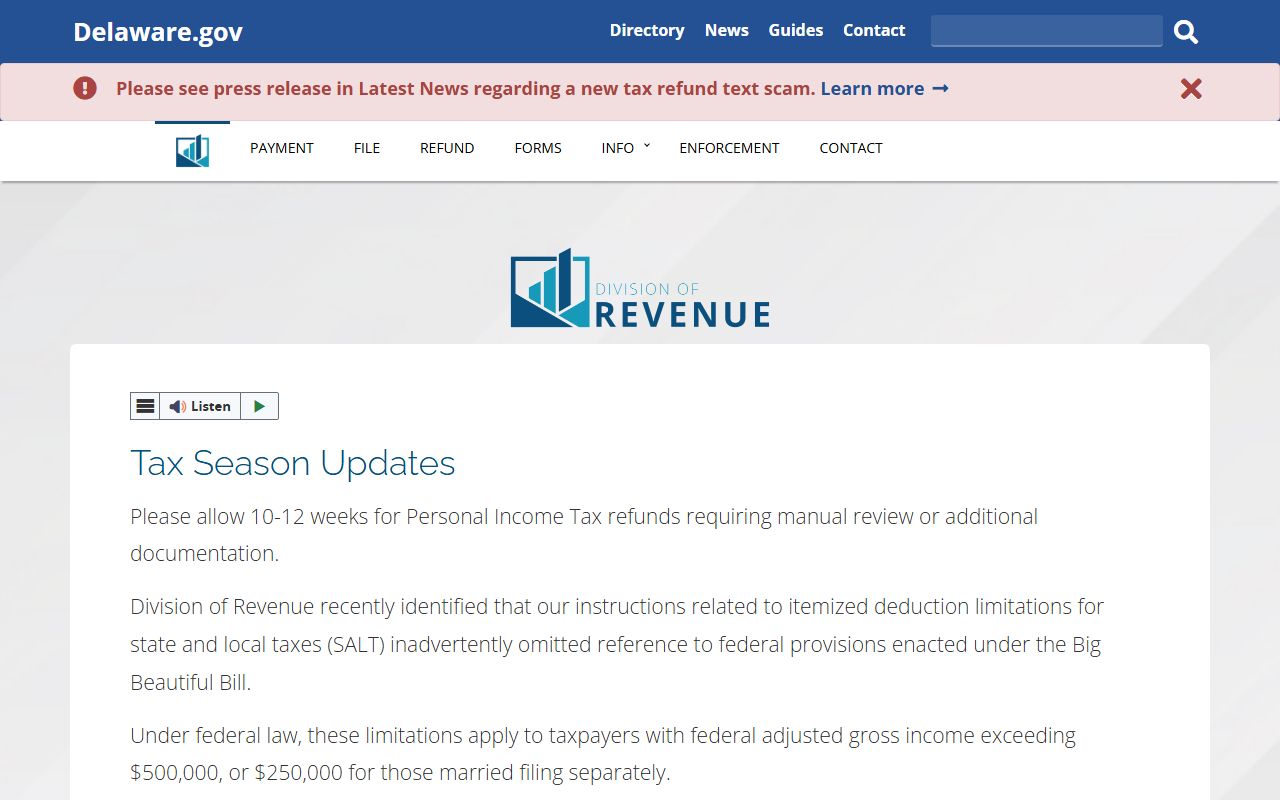
The Delaware Division of Revenue manages statewide tax administration. While property taxes belong to the counties, the Division provides forms, payments, and general tax guidance for all Delaware residents.
Search Delaware Property Tax Records Online
Each county offers a free online portal for looking up property tax records. New Castle County's parcel search is at nccde.org/parcel/search. You can search by address, owner name, or parcel number to find ownership data, assessed values, tax district details, and payment status. The Land Use Services department at 87 Reads Way, New Castle, DE 19720 also handles in-person requests at (302) 395-5400.
Kent County's Property Records System gives access to ownership, legal descriptions, sales history, source of title, transfer dates, and a full history of assessments. Search by owner name, street address, or parcel identification number. The Kent County Levy Court is at 555 Bay Road, Dover, Delaware 19901-3615, (302) 744-2300.
Sussex County's search portal at property.sussexcountyde.gov covers all 168,500-plus parcels in the county. Records are compiled from deeds, plats, tax maps, surveys, and other public sources. You can search by owner, street address, parcel ID, or advanced criteria. Sussex County also provides a GIS mapping application at maps.sussexcountyde.gov with zoning, flood zones, 911 addresses, and election districts layered over parcel boundaries.
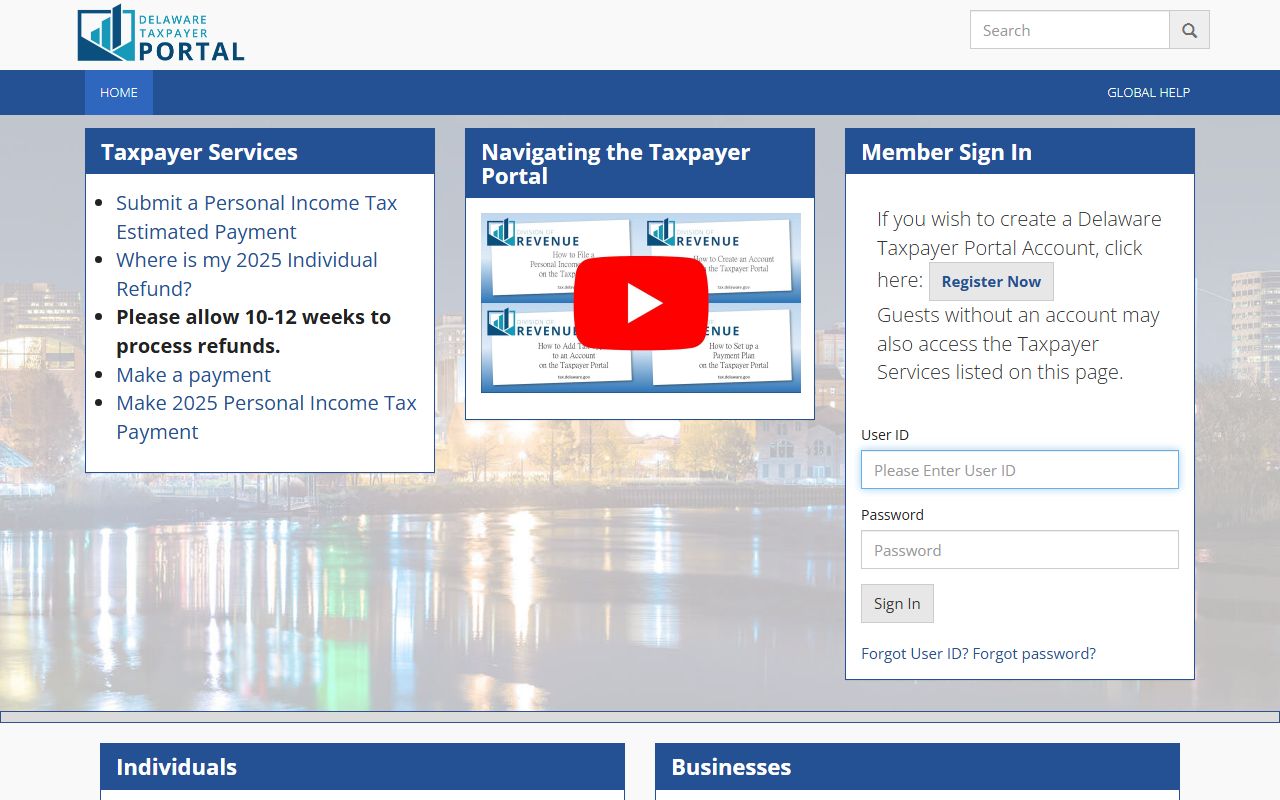
The Delaware Online Services Portal at tax.delaware.gov connects taxpayers to payment tools, refund status, and account services. For county-specific property assessment records, go directly to each county's parcel search portal.
Delaware Property Tax Assessment Laws
Delaware Code Title 9, Chapter 83 governs property valuation and assessment across all three counties. Section 8301 sets the core standard: all assessable property must be valued at fair market value as of the last reassessment base year. Each county board of assessment holds the authority to revise valuations and correct assessment errors. Section 8302 allows boards to correct errors at any time, with written notice required when a correction raises a property's assessed value.
Section 8303 mandates written assessment statements listing each owner, the property type, and the value, distinguishing between improved and unimproved land. Section 8310 sets public inspection deadlines. New Castle County must open completed assessments for public review by March 1. Kent County has until April 1. Sussex County's deadline is February 15. These windows give property owners a chance to spot errors before tax bills go out.
Sections 8328 through 8337 of Title 9 create special valuation rules for farmland, forest land, and horticultural properties. These provisions allow current-use assessment rather than development-value assessment, preventing forced conversion of agricultural land due to rising tax burdens. Section 8338 permits supplemental assessments on a quarterly basis to add new construction or correct omissions. Section 8341 blocks retroactive taxation through such supplemental assessments.
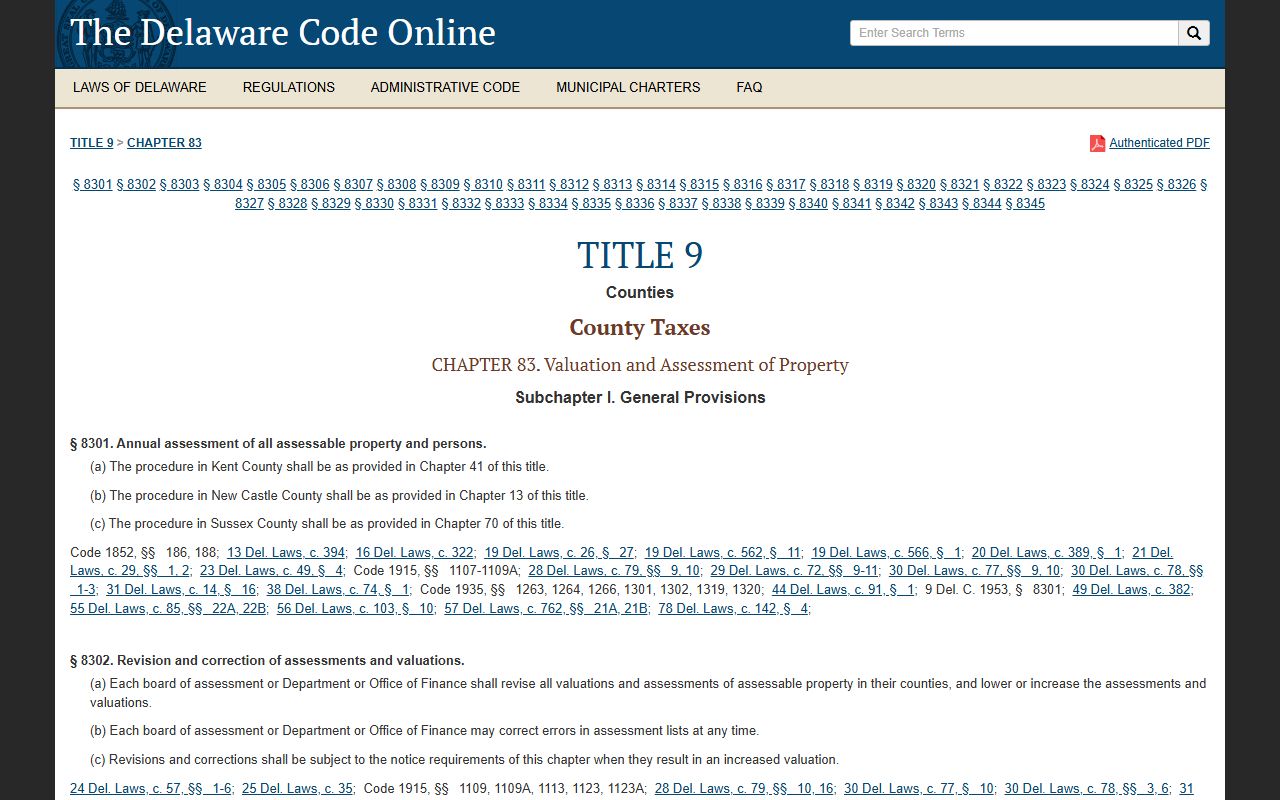
Delaware Code Title 9 is the authoritative source for all property assessment rules in the state. The statute covers valuation methods, appeal rights, public inspection requirements, and special land use provisions.
Delaware Property Tax Rates by County
Delaware property taxes vary by county more than in most states. New Castle County carries the highest median annual tax at $1,385, equal to about 0.55 percent of its median home value of $252,800. Kent County's median is $833 per year, or 0.40 percent of the $207,500 median home value. Sussex County has the lowest median at $662, which is 0.27 percent of a median home value of $243,700. Delaware's statewide median sits at $1,078 based on a five-year study from Property Tax 101.
These figures reflect the base-year assessment system. Counties that haven't reassessed in decades can show assessed values far below actual market prices. New Castle County completed a major reassessment in 2024 and 2025 using Tyler Technologies, bringing values up to reflect current market conditions. Sussex County also completed a court-ordered reassessment, with values set at fair market value as of July 1, 2023. That was the first Sussex reassessment since the 1970s. Following any reassessment, county tax rates are adjusted downward to maintain revenue neutrality, as required by state law.
A comparison of Delaware property tax rates across all three counties is available through propertytax101.org. The data illustrates the range in median tax burden depending on county location and home value.
Senior Property Tax Relief Programs
Delaware offers a Senior Property Tax Relief Program for homeowners aged 65 or older. To qualify at the state baseline, your income must not exceed $3,000 if single or $6,000 if married. The maximum homestead exemption is $5,000. Each county sets its own income thresholds and exemption amounts, which may differ from the state baseline. New Castle County and Kent County are also authorized under state law to create tax increment financing districts.
The state School Property Tax Credit adds another layer of relief. It equals 50 percent of school property taxes remaining after the homestead exemption is applied, up to $500 per year. Residents who moved to Delaware after 2018 must live in the state for 10 years before becoming eligible for senior tax relief. Once eligible, the exemption continues as long as the property remains the primary residence and the owner meets income requirements.
Municipalities handle senior discounts on their own. In Middletown, residents 65 or older who have lived in town for at least one year may apply for a senior property tax discount. The application deadline is July 1 each year. It is a one-time application with no renewal needed unless the address changes.
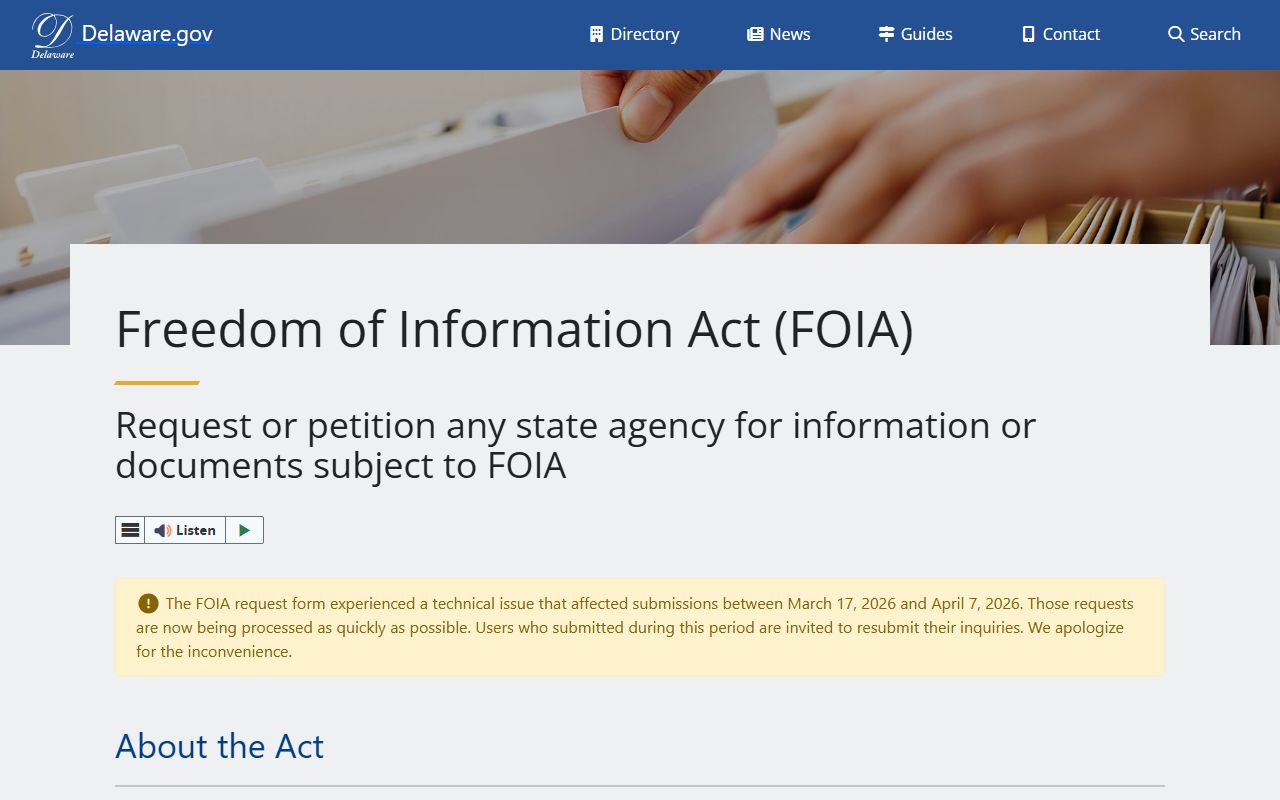
Delaware's Freedom of Information Act, codified at 29 Del. Code, Chapter 100, ensures that property tax assessment records and related data are available to the public. Most assessment files and billing records are open to anyone who asks.
First-Time Home Buyer Realty Transfer Tax Credit
Delaware gives first-time home buyers a break on the realty transfer tax. Effective August 2017, the state realty transfer tax rate rose to 2.5 percent in areas where local transfer taxes also apply, and 3 percent in areas without a local levy. Buyers and sellers typically split this tax equally. First-time buyers qualify for a one-half percent reduction on their share of the tax, dropping their rate from 1.25 percent to 0.75 percent. The reduction is capped at $2,000 and applies only to the first $400,000 of property value.
To qualify, all grantees on the deed must never have held a direct legal interest in residential real estate. They must also plan to live in the property as their primary residence within 90 days of closing. Use Form RTT-FHB to request a refund if you paid the higher rate after August 1, 2017. Full details and forms are available at revenue.delaware.gov. Taxpayer assistance is available at (302) 577-8783.
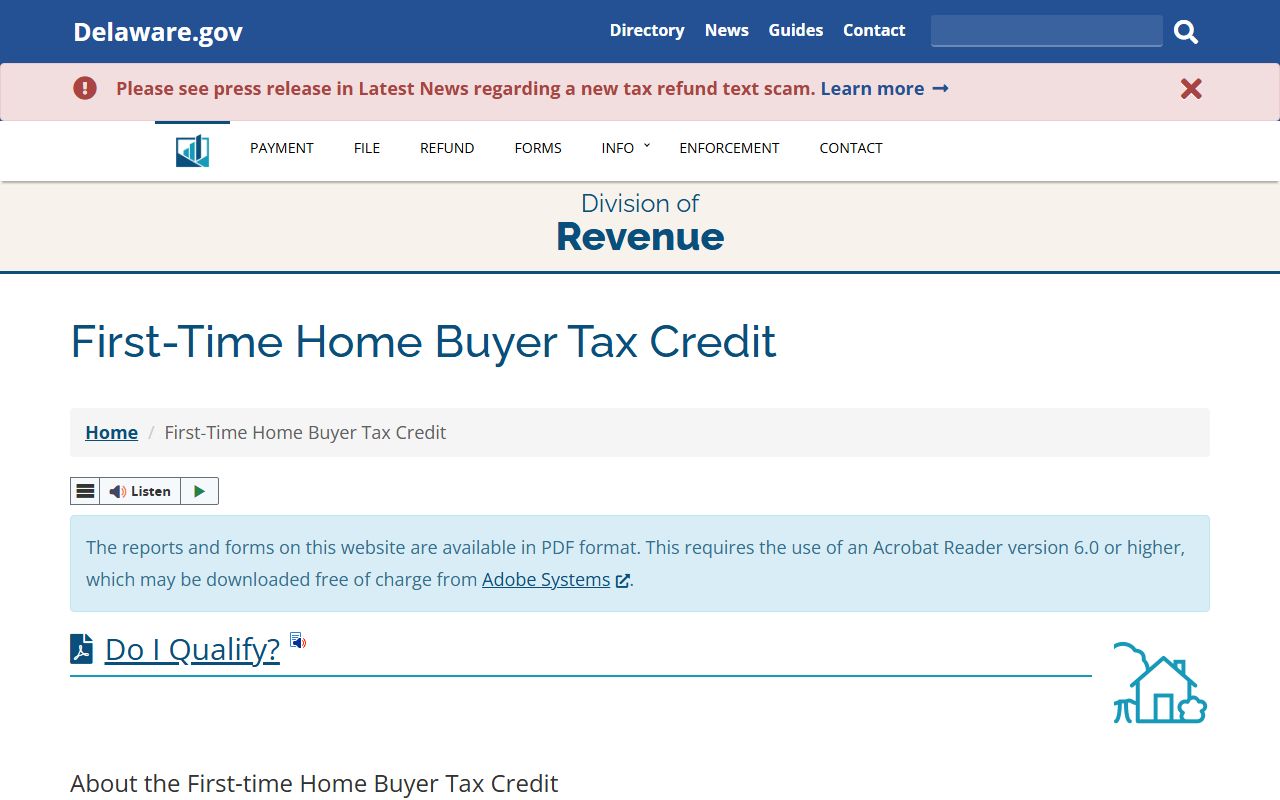
The Delaware First-Time Home Buyer Tax Credit page at revenue.delaware.gov explains eligibility requirements, the refund process, and Form RTT-FHB for buyers who overpaid at closing.
Accessing Delaware Property Tax Records Through FOIA
Delaware property tax records are public records under Delaware's Freedom of Information Act. The law states that citizens must have easy access to public records in order for the society to remain free and democratic. Most assessment records, billing histories, and parcel data are open to any person who asks. You do not need to explain why you want the records.
For state agency records, contact the Delaware Department of State FOIA Coordinator. Requests must be in writing and describe the records in enough detail for the office to locate them. You can submit online through the State of Delaware's Online FOIA Request Form, or by mail or in person at Delaware Public Archives, FOIA Coordinator, 121 Martin Luther King Jr. Blvd. N., Dover, DE 19901. The coordinator is also available at dos.foia@delaware.gov or (302) 739-4111.
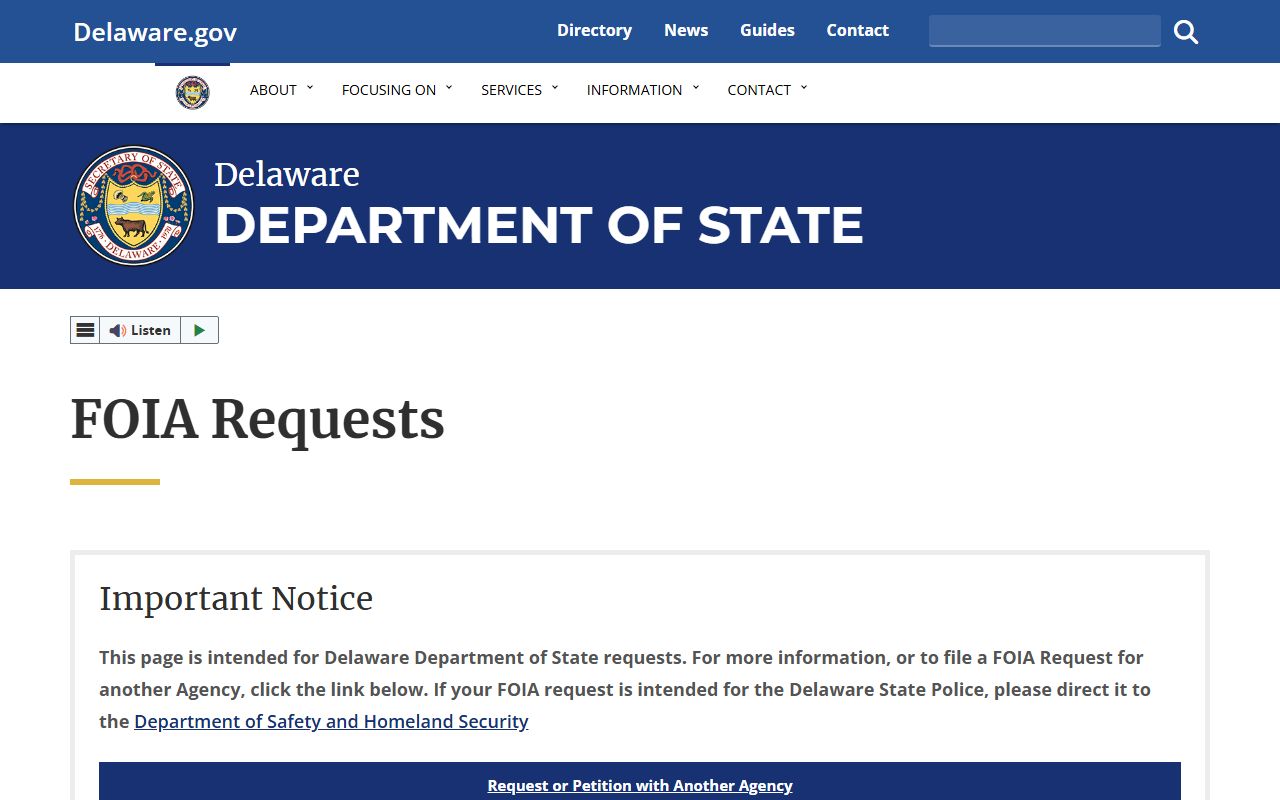
The Delaware Department of State FOIA office accepts written requests for state agency records. For county-level property tax and assessment records, contact the county's own offices directly.
County property records are generally accessible without a formal FOIA request. Each county's online portal provides free public access to assessment data, parcel information, and tax billing history. In-person requests at county offices are handled by staff who can pull records and provide copies.
Division of Revenue Contact and Forms
The Division of Revenue maintains offices in three Delaware cities. The Wilmington office is at 820 N. French Street, (302) 577-8200. Dover is at 540 South DuPont Highway, (302) 744-1085. Georgetown is at 20653 Dupont Blvd, (302) 856-5358. Personal income tax assistance is available at (302) 577-8200 or DOR_PublicService@delaware.gov. Director of Revenue Kathy L. Revel can be reached at (302) 577-8686.
The Division of Revenue forms library provides downloadable personal income tax forms, business tax forms, and property-related filings for current and prior tax years. When filling out forms digitally, download them first before completing to get the best results. Electronic filing is available at revenue.delaware.gov/file and is generally faster than paper submissions.
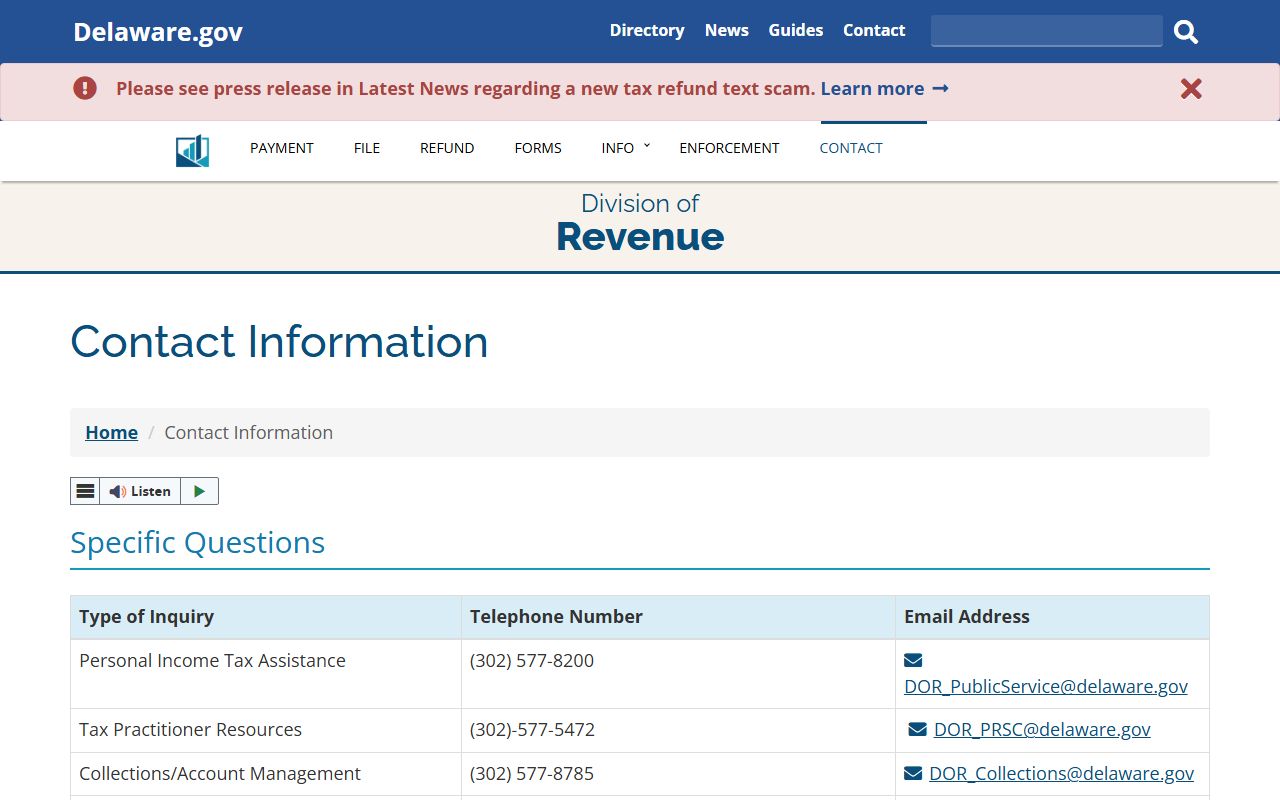
The Division of Revenue contact page lists direct phone numbers and email addresses for all tax assistance functions including personal income, business licensing, corporate tax, and refunds.
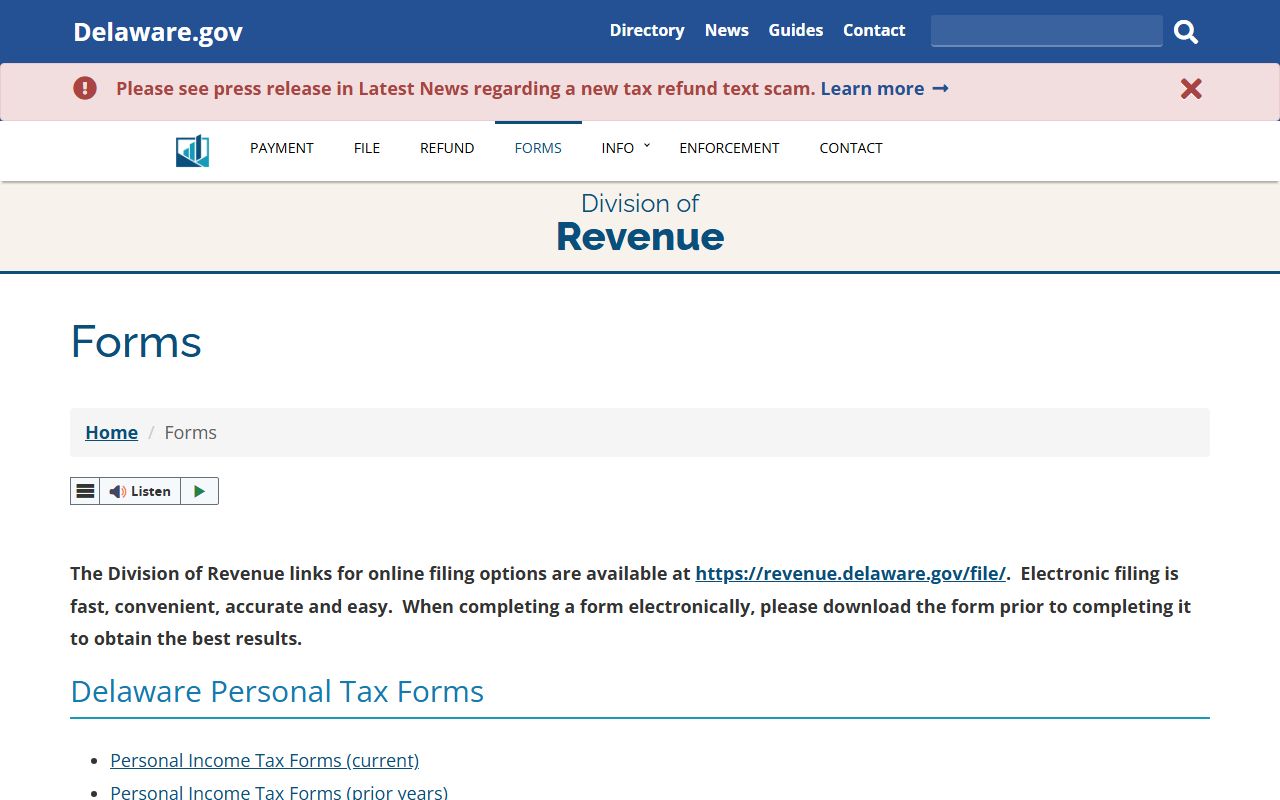
The Delaware Division of Revenue forms page provides access to all current and prior-year tax documents. Forms including RTT-FHB for first-time homebuyers are available for free download.
Note: Beginning October 2025, estimated taxes for corporate, fiduciary, and composite returns became available through the online portal at tax.delaware.gov.
Browse Delaware Property Tax Records by County
Delaware has three counties. Each one maintains its own property assessment and tax collection system. Select a county to find contact information, online search tools, and local details for property tax records in that area.
Property Tax Records in Major Delaware Cities
City residents pay both county and city property taxes. Select a city below to find local tax rates, billing dates, and where to search property tax records for that location.