
Milford Property Tax Records
Milford property tax records cover a unique situation in Delaware: the city straddles both Kent and Sussex counties, so property assessment information comes from both county systems depending on where a parcel sits. The city itself bills and collects Milford taxes on an October-through-September tax year, with bills mailed in August each year. This page explains how to find Milford property tax records, how the city tax rate works, what exemptions are available, and where to access the county-level records that back up city assessments.
Milford Overview
Milford Property Tax Payments and Rates
The City of Milford Tax Payments and Assessments page is the starting point for all Milford property tax questions. The tax rate for the 2024-2025 tax year is $0.59 per $100 of assessed value. To calculate: take the assessed value, multiply by 0.0059, and that is your annual city tax. For the 2025-2026 tax year, the rate rises to $0.60 per $100. The formula shifts to: assessed value multiplied by 0.0060.
The Milford tax year runs from October 1 through September 30. Annual tax bills go out in August and are due in September. For questions about your online tax account, bill, or the Senior Citizen Exemption, call Customer Service at (302) 422-6616. Copies of the 2025-2026 General Assessment are posted at Milford City Hall, 201 South Walnut Street, Milford, Delaware.
The city executes annual tax billing, supplemental billing for new construction or changes, and handles all real estate tax payment collection internally. Property assessment itself is conducted by a professional firm through a contractual arrangement rather than by city staff.
The Milford Tax Payments and Assessments page shows the current tax rate, the calculation formula, and information about exemptions including the Senior Citizen and First Time Homebuyer programs.
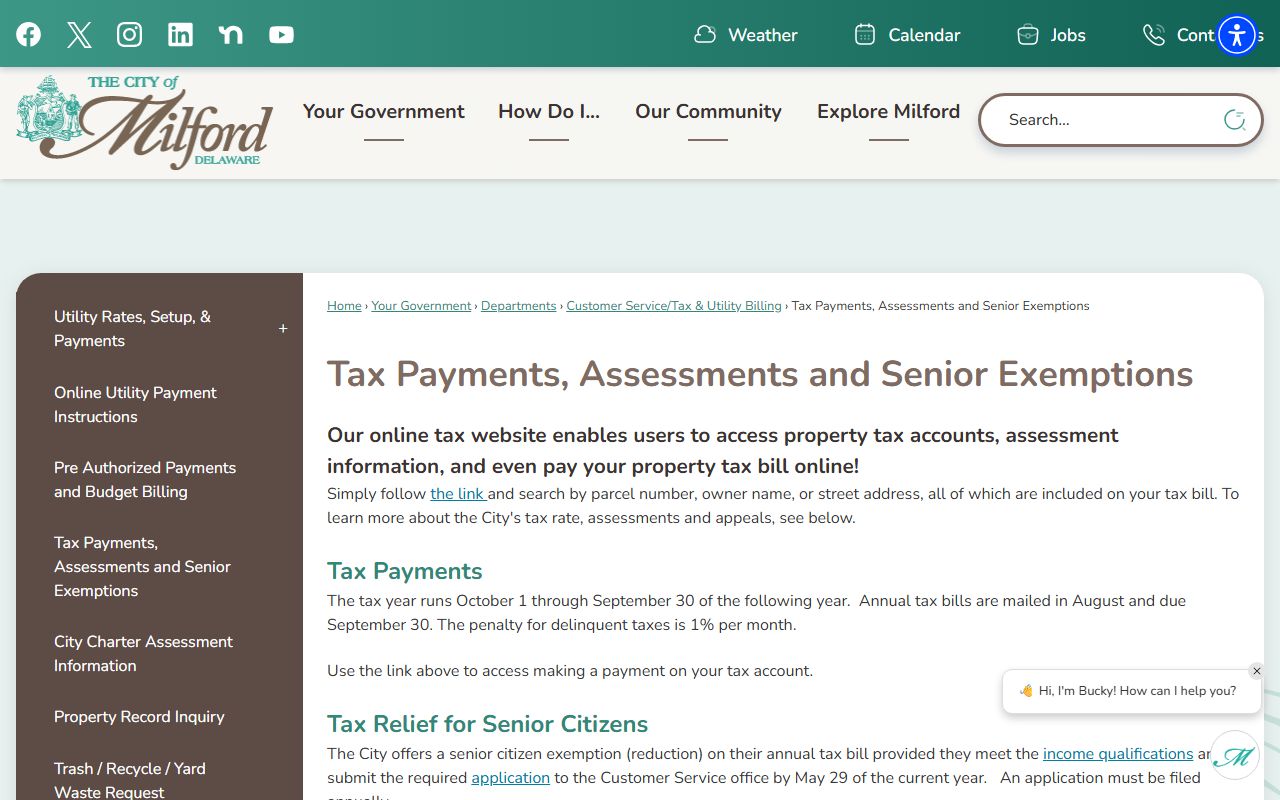
The tax year runs October 1 through September 30, with bills mailed in August. Customer Service at (302) 422-6616 handles bill and exemption questions.
Milford Tax Billing Schedule and Liens
Milford follows a set billing schedule laid out in the City Charter. July 1 is the Levy Date, which is when the enforceable lien on each property takes effect. August 1 through September 30 is the Face Payment Period, meaning bills paid in full during this window are paid at the standard rate. Beginning October 1, unpaid taxes accrue a penalty of 1 percent of the cumulative past-due balance each month.
Under Milford City Charter Section 7.11, unpaid taxes become a first lien against the real estate for ten years from July 1 of the tax year in which they were levied. If the property remains in the owner's possession at the time of assessment, the lien continues until the tax is collected. The City Manager has authority to file suit to recover unpaid taxes. If necessary, the city can pursue a monition sale of the property under the procedures in Chapter 87 of Title 9 of the Delaware Code. Written notice is required at least 30 days before any legal proceeding starts.
The City Charter also limits total tax revenue: under Section 7.10, the tax rate for current expenses cannot produce a sum exceeding 2 percent of the assessed value of all real property in the city. This cap protects property owners from runaway tax increases year over year.
Milford Tax Exemptions
Two main exemptions are available to Milford property owners. The Senior Citizen Exemption reduces the tax burden for qualifying older residents. Contact Customer Service at (302) 422-6616 to ask about current eligibility requirements and how to apply. Senior exemptions are subject to income and residency requirements that can change from year to year.
The First Time Homebuyer Exemption is available under Milford City Code Chapter 178.2D. No city transfer tax is imposed on property transfers where all grantees qualify as first-time home buyers. To qualify, all buyers must never have held any direct legal interest in residential real estate and must intend to use the property as their primary residence. This exemption applies to the city's portion of the transfer tax. Separate state-level first-time buyer benefits may also be available through the Delaware Division of Revenue.
Milford Real Estate Transfer Tax
When property changes hands in Milford, both city and state transfer taxes apply. The City of Milford transfer tax rate is 1.5 percent of the property value, as reserved under City Charter Section 7.12. The State of Delaware realty transfer tax adds another 2.5 percent. Combined, the total transfer tax on most Milford sales is 4 percent. Realty transfer taxes are typically split equally between buyer and seller under Delaware standard practice, though parties can negotiate who pays what in the sales contract.
First-time homebuyers may qualify for a reduction in their share of the state realty transfer tax. Under Delaware's first-time homebuyer program administered by the Division of Revenue, the buyer's state rate may be reduced by 0.5 percentage points, from 1.25 percent to 0.75 percent, capped at $2,000 and applicable to the first $400,000 of property value.
The Milford City Charter lays out the tax lien rules, transfer tax authority, billing schedule, and the limit on total tax revenue that the city may collect in any given year.
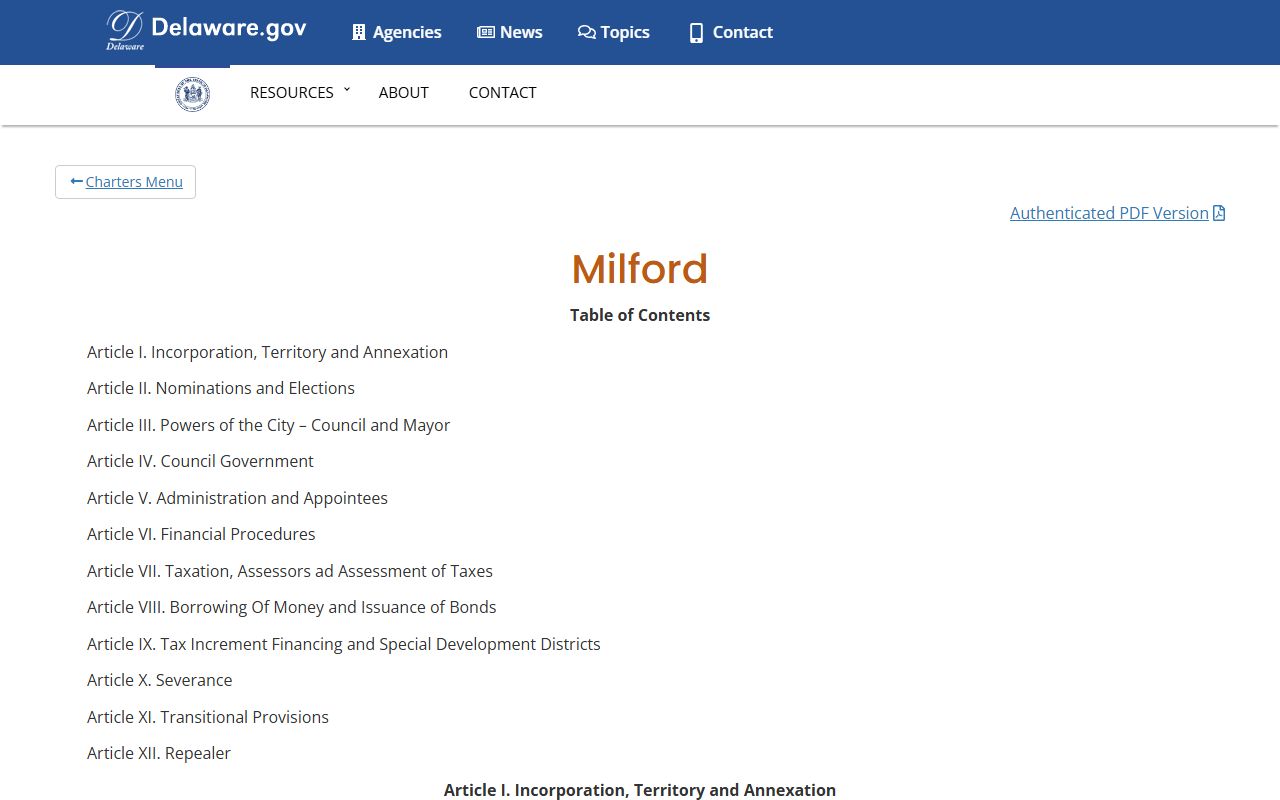
Section 7.11 of the charter establishes a 10-year first lien on real estate for unpaid taxes, starting July 1 of the year the taxes were levied.
County Assessment Records for Milford
Because Milford sits in both Kent County and Sussex County, the county that handles your property's assessment depends on where your parcel is located. Parcels on the Kent County side use the Kent County property records system. Parcels on the Sussex County side use the Sussex County property search portal. Both tools are free and search by owner name, address, or parcel ID.
If you are not sure which county your Milford parcel falls in, both portals allow searches by address and will return results if the parcel is in their jurisdiction. You can also check with Milford City Hall at (302) 422-6616. The city billing staff can tell you which county's assessment applies to your property and the current assessed value used for billing. Delaware Code Title 9, Chapter 83, specifically Section 8301 and related sections, governs how both counties assess property values.
For deed research on Milford properties, the county recorder offices maintain historical deed records. Kent County deed records go back to January 30, 1874 in digital form, with books dating to Dutch land grants from 1646. Viewing is free. Sussex County deed records are available through the county's property search tools. Both deed databases give you ownership history and chain of title for any Milford parcel, which is essential when buying, selling, or refinancing property in the city.
Nearby Cities
Milford is centrally located near several other Delaware cities with their own property tax pages.