
Newark Property Tax Records
Newark property tax records include parcel-level assessment data for all taxable real estate within city limits. The City of Newark, Delaware publishes its real estate tax assessment list online, where you can search individual properties by parcel number, owner name, or address. Newark is located in New Castle County, which handles all property assessments. The city applies its own tax rate to those county-determined values when billing property owners each year. This guide covers where to find Newark property tax records, how the assessment list works, and what changed after the 2024 reassessment.
Newark Property Tax Overview
Newark Real Estate Assessment List
The City of Newark publishes its Pending 2024-2025 Real Estate Tax Assessments as of April 1, 2024, at newarkde.gov/taxassessment. The list runs over 214 pages and covers all taxable parcels within the city. Each entry shows the parcel number, property class, owner name, owner mailing address, property address, subdivision name, lot size, land assessment, building assessment, any exemptions, and the taxable amount after exemptions.
Property classes in the list use letter codes. R stands for Residential. C stands for Commercial. E stands for Exempt. Zone codes provide additional detail. For example, zone 18RS means Residential Single-family. Subdivision names appear for planned communities like Nottingham Manor, Hunting Hills, Arbour Park, Devon, and The Hunt at Louviers. Condominiums, living trusts, and estates are all included and labeled accordingly.
A typical entry looks like this: parcel number, class, owner name and mailing address, property address with city, zone code, lot dimensions, land value, building value, and total assessment. Some entries show a $50,000 exemption reducing the taxable amount for qualifying properties. This list is the city's official record of what each property owner is expected to pay taxes on for that assessment year.
Newark Property Tax Rate
Newark's current city tax rate is $0.2385 per $100 of assessed value. This rate replaced the prior rate of $1.08 per $100 following the 2024 New Castle County reassessment. The rate dropped substantially because the assessed values themselves increased significantly. The adjustment was designed to be revenue neutral. The city does not collect more total tax money just because individual assessed values went up.
Finance Director Jill Hollander explained the mechanics publicly in May 2020. New Castle County was ordered by the Court of Chancery to reassess all properties because values had not changed since 1983. Over four decades, market prices moved but assessed values stayed frozen. The reassessment corrected that by bringing values in line with current market conditions. Once that happened, every taxing entity in the county had to recalculate its rate to avoid a windfall. Newark's rate dropped from $1.08 to $0.2385 to match the new higher base values.
While total city revenue stays the same, individual tax bills may go up or down. It depends on whether a specific property's new assessed value rose more or less than the county average. Properties that were underassessed relative to market conditions tend to see tax increases. Properties that were closer to market value under the old system may see little change or even a decrease.
Tax bills go out in August. The City Council votes on the rate before billing. If you want to estimate your Newark property taxes before the bill arrives, multiply your assessed value by 0.002385. That gives you the city portion of your annual tax obligation.
Using the County Parcel Search for Newark Properties
Because assessments are set by New Castle County, the county parcel search at http://www3.nccde.org/parcel/search is an important tool for Newark property owners. It shows ownership information, assessed values, tax district details, and payment status. You can search by address or owner name if you do not have a parcel number. The system is free and does not require registration.
The county's Office of Finance handles tax collection and maintains records on assessment values, tax payment status, and any outstanding balances. If you want to pay Newark county taxes online, you can do so through the Finance portal. Pre-payment of property taxes is also accepted by the county.
Legal Framework for Newark Assessments
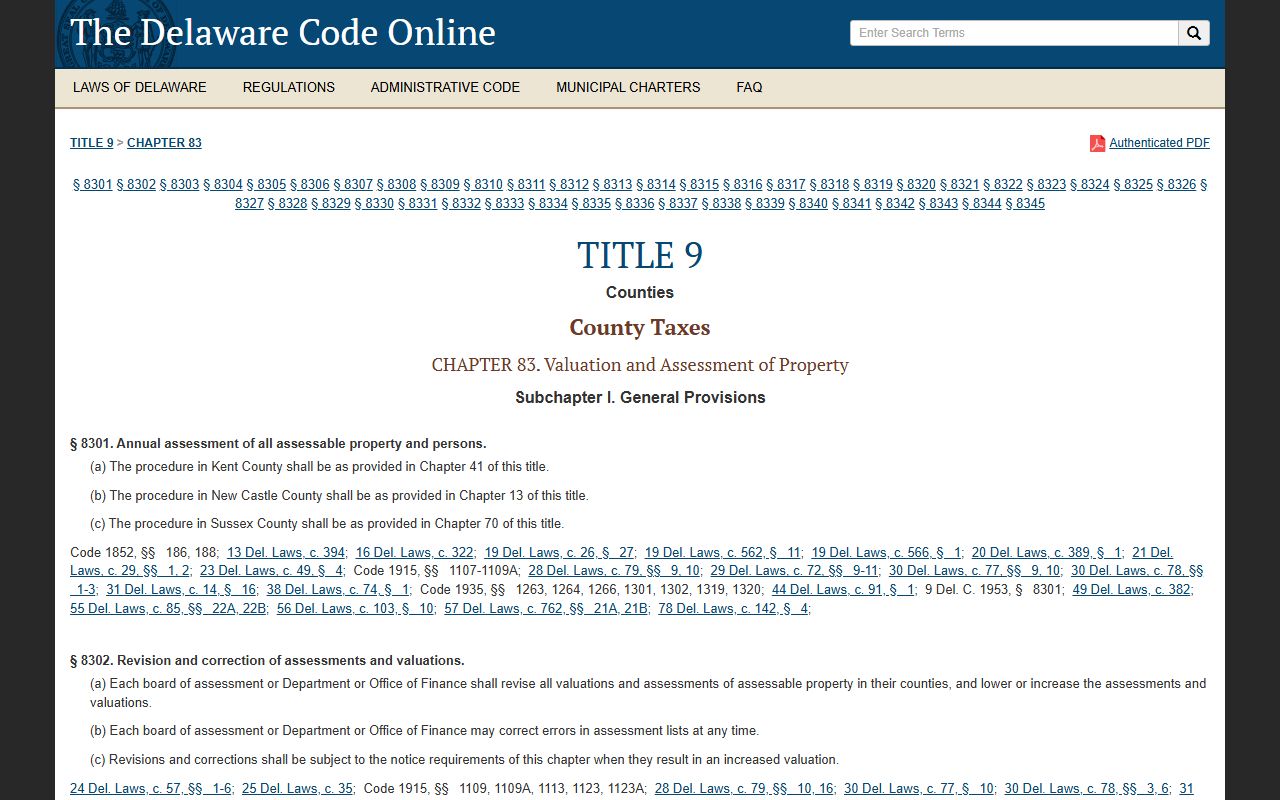
All Newark property assessments follow Delaware Code Title 9, Chapter 83. Section 8301 requires that properties be assessed at fair market value as of the most recent reassessment base year established by the county. Section 8310 requires New Castle County to make completed assessments available for public inspection by March 1 of each year. These legal requirements ensure that assessment records are public and accessible before tax bills are sent out.
Under the same code chapter, property owners have the right to appeal assessed values they believe are incorrect. Appeals go to the New Castle County Board of Assessment Review. You need to file by the annual deadline, gather comparable sales or other evidence, and present your case either in a stipulation process with county staff or at a formal hearing. If you disagree with the Board's decision, you can appeal to the Superior Court within 30 days of receiving the written ruling.
The Delaware Division of Revenue and the Delaware Tax Portal cover state-level tax obligations. Property tax is a county and municipal matter in Delaware, but state law governs the framework within which those taxes are set and collected.
How to Read the Newark Assessment List
The Newark assessment list at newarkde.gov/taxassessment uses a specific format for every entry. The parcel number appears first, followed by the property class letter (R for Residential, C for Commercial, E for Exempt). Then comes the owner's full name and mailing address, the property address with a two-digit zone code, lot dimensions in feet, land assessment, building assessment, and the total taxable amount after any exemptions are subtracted. Reading all these fields together gives you a complete picture of any parcel in the city.
Zone codes help locate properties within Newark's planning districts. Zone 18RS means single-family residential in area 18. Condominiums show unit numbers as part of the address field. Trusts and estates appear as the owner name. Some entries list a $50,000 exemption on the taxable line. This typically corresponds to a state or local homestead or senior exemption that reduces the tax base.
If you find a discrepancy on your entry, contact the city. Wrong owner names, incorrect lot sizes, and misapplied exemptions can all be corrected. The appeal process runs through New Castle County for assessed value disputes, but administrative corrections at the city level can often be handled directly through the Newark tax office.
State law under Delaware Code Title 9, Section 8302 allows assessment boards to correct errors at any time. Written notice is required if a correction results in a higher taxable amount. Property owners have the right to see any increase before it takes effect on a tax bill.
Public Records Access for Newark Properties
Newark property tax records are public documents. Delaware's Freedom of Information Act at delaware.gov/freedom-of-information-act makes most government records open to any person who requests them. Assessment lists, billing history, and parcel data do not require a specific reason or eligibility to access. You can visit the city, submit a written request, or use the online tools available through the city and county.
The Delaware Division of Revenue handles state-level tax matters, including realty transfer taxes and first-time home buyer credits. Their Wilmington office at 820 N. French Street can assist with questions that cross between state and local tax systems.
Nearby Cities
These cities in New Castle County also rely on county-set assessments for local property tax billing.